Wednesday, October 31, 2012

"Sewing" in the garden

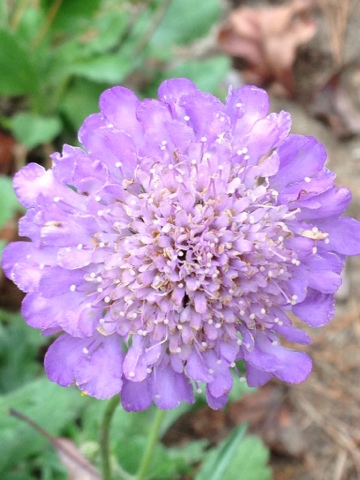
In the days just before Sandy arrived, I was out in the garden cleaning up in preparation for winter (now I have a lot more to clean up but that's material for another day's post) and took a couple of pictures of some of the last few blooms. The pincushion flower (Scabiosa caucasica) was bravely putting out some of its lovely light purple blooms. I captured some of the unopened blossom heads from which the flower takes its name.

According to my copy of Better Homes and Gardens New Complete Guide to Gardening, pincushion flowers are some of the longest blooming perennials at 10 weeks and even more if dead headed to encourage blooming. The author also listed these flowers as good plantings for rock gardens, providing food for songbirds and attracting butterflies.

Tuesday, October 30, 2012

My Toggili Barometer and hurricane prediction

My father came to own this little vintage Toggili Barometer and Thermometer house from his aunt and uncle. I'm not sure where they got it from. This little house sat on the shelf at our lake house for years and it did a great job in predicting the weather.

While we were cleaning out the house in preparation for selling it I wanted to keep the little house as a reminder of our time at the lake and of my father. I brought it home and put it out on our three season porch and the little girl stood out indicating good weather even on a few raining days. I was concerned that moving it had caused it to stop working correctly. On Sunday prior to Hurricane Sandy's arrival I noticed the little man had swung out of the house. Low atmospheric pressure indicates that stormy, rainy, windy weather is on the way. In the case of a hurricane the lower the atmospheric pressure the more intense the storm, and Sandy is now the storm with the distinction of having the lowest recorded pressure readings at 940 millibars.

Thursday, October 25, 2012

Signs of the coming winter

This morning, after opening the garage door I could hear a strange noise. I stopped walking to my car in order to focus in on the sound and interpret what it was. Honking, the honking of geese. Odd because to me it just seemed too dark and early for them to be in flight overhead but within minutes the sky began to brighten and the sun rose shortly there after.

For some reason this year I have noticed more and more of the famous flying V formation that flocks of geese adopt. Last winter was so mild that I don't think many of them took off for southern climes. You could see them foraging for remnants in the corn and other vegetable fields around the area. They were to be seen hanging around local ponds and golf courses. The fields around the high school in Lincoln, RI is inundated with them. They were crossing the street and early this summer when I drove by I saw for the first time a Canada (not Canadian according to the National Geographic's site) goose as a road kill victim.

So what's up with the flying V formation? According to The Library of Congress's fun science facts page on the subject, the formation allows for faster and more efficient flying. The birds in front provide a reduction in strong wind currents allowing for birds in the rear to get a break. Then the birds take turns in the formation in order to share the work. It also helps to keep everyone together and in communication.

One last thing, perhaps you have seen this one at work but it's worth a read. Lessons From the geese is "cute" but it is a good reminder for us from time to time. Being part of a flock can be hard, and sometimes we need to remember to be grateful for the birdbrains around us.

Monday, October 22, 2012

Thank you deer!

No that isn't a typo, thank you deer, for the help with trimming back the hosta plants before winter. Actually they have been at it all summer. I'd go out to find that someone had been nibbling here, there, and everywhere. They did a number on the plants, the only ones that didn't suffer were those planted close to the house. In the past I have sprayed the leaves with Deer Away which works pretty well. I have to be perfectly honest, this summer I simply didn't have the time or energy to patrol the garden and try to keep the pesky deer in their place. Bambi, enjoy what you got this summer because next year things will be different!

Sunday, October 14, 2012

Yesterday's killing frost

Fall is definitely here now. Yesterday morning we woke to a heavy frost and even the heat in the house kicked on. It was 29 degrees out. The leaves have been falling out of the trees at a much faster pace today. I love fall time but it can be a tad depressing once the trees are all bare. Here is one shot of the frost on the roof top where the sun hadn't melted it yet. The other is the evidence of the killing effect of the frost on the sunflower plants edging the patio.

Thursday, October 11, 2012

Turkey tail

On an old stump in the yard a beautiful cluster of turkey tail bracket fungi (Trametes versicolor: The Turkey Tail) has started to grow. Fungi are organisms which feed off of dead matter. They are absorptive feeders which excrete digestive enzymes tombreak down the substrate upon which they are growing and consuming. Then the nutrients are absorbed into the fungi's cells which are called hyphae. The cells are long thin filaments which create a woven mat like structure known as a mycelium which can be seen in the photos below. Fungi reproduce by generating and releasing spores which are carried away by wind, rain, or animals. Once the spores find a suitable food source with plenty of moisture and the right temperatures they will begin to grow.

The Turkey tail fungi grows mainly on hardwood stumps or dead branches here in the forests of New England. These are growing on the stump of a maple tree that we had cut down almost two years ago as its large branches threaten the roof of the house. Thankfully we did take the tree down before last year's freak Halloween snowstorm which certainly would have caused some damage to this tree. 

Tuesday, May 31, 2011

"Who cooks for you?"

I was startled awake this morning by the call of a barred owl with its characteristic "Who cooks for you?" hooting pattern. It took me a few moments to figure out what I was hearing. At first I thought it was someone talking, but then realized that the sound was coming from outside.

Dear Owl, no one cooks for me as I am the cook in my household. And Owl, after you woke me at 4:30am, I definitely would have enjoyed someone else cooking up my breakfast this morning, or for that matter, packing my lunch for work, and fixing dinner when I got home. I guess I'm lucky Owl didn't make me breakfast as I am not a fan of small rodents for my morning meal.

Monday, May 30, 2011

Quiet Morning Noises

This morning is very still with hardly a breath of breeze. On such a morning as this you can really hear everything around you. I could hear the raindrops hitting on the leaves. The maple seed helicopters twirling down to the ground. All types of birds calling. (During the night I could hear the bull frogs out in the swamp behind the house). I could even hear the high school marching band's drum line starting up for the annual Memorial Day Parade that begins at the VFW a mile away as the crow flies. Calming, peaceful, and a chance to be contemplative.

Sunday, May 29, 2011

Bridal Bush

Bridal bush or Spirea vanhouttei is one of those plants that invoke a special memory for me. During the 1970s and early 80s my father and a friend of his invested in real estate along the Rhode Island coast in a small town call Misquamicut. The first property they bought was a year round Cape Cod style house situated approximately one mile from the beach. The yard was surrounded by a hedge of Bridal bush that was loaded down with blossoms each May/June. I can still picture it. Even on a foggy morning the hedge radiated its white beauty. I promised myself that I would have such a plant in my yard when I grew up.
A couple of years ago I purchased two one gallon sized plants and put them in the little hollow on the edge of my sun/shade gardens and there they have flourished. The spot is currently filled with white blossoms that are the envy of any bride's bouquet.

Wednesday, April 27, 2011

Learn something new every day

Male wood duck
Yesterday morning while looking out the bathroom window on the second story, I noticed an unusal bird in a tree at my eye level. I saw that the bird was not alone, further along on the branch was another which I assumed to be its mate. My husband managed to get these shots of the two birds. They aren't the best as they were taken from some distance but it allowed us to make an identification - wood ducks. Ducks up in a tree? Well, it turns out wood ducks often will nest in a tree or man made duck boxes. Their young when ready to leave the nest will hop down to the ground or water below the tree. I did not know that. You can learn something new every day.


Female wood duck

Tuesday, April 26, 2011

Bird Songs

Smells evoke memories or so they say, but don't sounds as well? There is an early morning sound that I associate with spring, and I heard it again today and was determined to figure out its source. I am speaking of course of an early bird's song. Being a tad old fashioned I first went to my book shelf for my copy of Judy Pelikan's The Music of Wild Birds: An illustrated, annotated, and opinionated guide to fifty birds and their songs adapted from the work of F. Schuyler Mathews. At first I thought it was the American Robin making the sound based on a line of poetry quoted, "Cheer up, Cheer up." That led me to technology and an on-line search for more information. I started by looking up F. Schyler Mathews and listening to the sound links there for the robin. That's not who I was hearing. Next search took me to eNature field guides and the real culprit the black capped chickadee.

I was confused. I was familiar with the chickadee's name sake call, but not its song. That's when I learned that there is a difference between a bird's song and its call. The call is used for communicating a warning or identifying a location. The song on the other hand is used for finding a mate. With it being spring, and mating season, the chickadee is using his song more than his call. Mystery solved. Now I know who to say good morning to when I'm out the door early and on my way.

Saturday, April 02, 2011

It's April You Fool

Spring in New England is always a surprise. Yes, you can get snow in April. Yesterday, on April Fools Day we received a few inches of heavy wet snow and this morning it is already melting away. In fact in order to get this photo I had to rush outside before all the snow melted away.


Just when I was ready to have a Saturday available to work out in the yard it has to snow and make it too muddy to do anything. Here in New England we classify the seasons by Winter, Summer, Fall, and Mud. By Monday everything should be melted away, but then I will be back to work and too busy to get anything done. Let’s hope next weekend’s weather will be more cooperative.

Thursday, August 13, 2009

Sounds to wake up to

This morning, I awoke to the sounds of gentle rain falling, the gurgling of the drain spout, and birds singing. Not so yesterday. Yesterday, the sound was the flapping of a bat's wings. My husband had gotten out of bed and shut off the attic fan that had run all night. When the fan blades had stopped, and quiet settled in, my husband could hear a rustling noise out in the hallway. He tracked the source of the sound to our spare room, behind the door was a bat. He quickly shut the door to our son's room so the bat couldn't enter it, and then came to shut our door which he had left opened. That's when I heard it. The rustling, fluttering noise was now in our room. I opened my eyes to see a bat flying around the room over me. "Wait," I cried, "you've trapped it in here with me!" The bat had followed him down the hall into our room.

My knight in shining pajamas returned with a small trash can to do battle with the dreaded, flying mammal. He managed to trap the bat up against the wall. Between the two of us, me opening the window, him carefully sliding a magazine between the trash can and the wall, we carefully maneuvered the trapped bat to the window to be released. We knew there were bats up in our belfry, but never imagined they would enter the floors below.

What is it about bats that we so dislike? Is it that they only come out at night? Is it our association with the vampire legend? Without them we would be over run by insects. In some ecosystems they play a key role as a pollinator of plants. Anyway you look at it, I prefer the gentle sounds of rain first thing in the morning to the flapping of wings overhead. Complaining about the weather can be another day's entry.

Sunday, August 02, 2009

Red Shouldered Hawks

Over the years we have had Red Shouldered Hawks (Buteo lineatus) nesting in or near our yard. This year the nest must be in a tree in the neighbor's yard across the street. I can hear their distinctive call in the yard and woods behind as they fly between the two houses. Our yard bordering the wet lands is situated near their favorite food sources. Plus I hate to admit it, our bird feeder may tempt them with an easy meal from time to time.

A couple of days ago I witnessed something unusual, three hawks landed in the same pine tree out back. I needed to figure out whether or not this variety of hawk exhibited this grouping behavior. According to the website above parents will feed their young for 8 to 10 weeks, and it will be up to 17 to 19 weeks before the young are independent. I've gotten to wondering if what I've been witnessing is the young learning to hunt under the tutelage of one of their parents. I have not been able to tell if it is a male or a female adult and young. Then move quickly and haven't perched for long. It is amazing to see them glide through the woods.

Saturday, August 01, 2009

The Farmer's Market vs. The $64 Tomato

Okay I write about my garden, but the one thing you won't find in it is vegetables. The first summer we were at this house, I really didn't have the time to establish a vegetable garden so I figured I would simply grow some herbs and tomatoes in flower tubs on the deck. I had a couple of grape tomato plants and they were doing great. The little tomatoes were coming along and just when they were about to ripen, poof they were gone. The only evidence to support where they had gone was a half eaten one. Chipmunks!!! Chip and Dale of Disney fame they are not. I do not consider them cute and cuddly when they are destroying the garden. Pluto (remember Mickey's dog, not the planet that lost its planetary status) did not like those two chipmunks. Mickey tried to convince Pluto of their innocence, but Pluto like I know the truth. They're varmints of the worst kind.

Second animal problem - deer! Our lot borders wetlands and the deer live in the woods out back. They come out to feast on hosta, daylily buds, cone flower, tulips, etc. etc. etc. I would need a large fence to keep them out. This brings me to the title of today's post: "The Farmer's Market vs The $64 Tomato. If you ever get the chance, read William Alexander's book The $64 Tomato in which he recounts his experiences of building his garden and orchard. In one of the chapters he finally breaks down to calculate how much it has cost him to grow the tomatoes in his garden. After tallying up the cost of soil, compost, materials, plants, professional help, etc, etc, etc (there's a lot of those) he comes down to the bottom line - it costs $64 to grow one tomato. Well with those numbers, I might just as well go visit the local farmers that gather on the town field every Saturday morning (see this link for more info). I'll buy their tomatoes, corn, squash, etc. for a lot less. I'm still tempted at some point to dig up a section of the lawn, enclose it with a fence and plant some vegetables, but it won't be this summer.

Wednesday, July 29, 2009

Reading the opening pages of Jamaica Kincaid's book My Garden (Book): I was inspired to reflect on my own first garden. I don't count my first gardening experiences as taking place in my own garden since they occurred in my mother's garden. We had a small plot next to the house where we managed only to grow green beans and a patch of rhubarb. My first garden is really the one I started when my husband and I purchased our first house.

We purchased the house in March, and once spring really arrived here in New England I came to know that there were no plants in the yard except for a few shrubs in the front of the house. As a novice gardener I promptly went out and purchased what was in bloom at the garden center and planted. I discovered that certain plants only bloom at certain times in the growing season. I had early spring/summer bloomers. By July my blossoms were spent along with my modest budget for plant purchases.

The following year I did a little more research and purchased summer blooming perrenials and annuals. Now I had two seasons covered. Being a weekend gardener I still didn't know the lay of the land or should I say the path of the sun. It wasn't until I became a stay-at-home parent that I could fully come to know my yard. I had bought plants only to discover I had planted them in the wrong places. Some marked "full sun" couldn't handle the "full sun" that I had. They were better suited for partial sun spots. Some "shade" plants needed more sun than I was giving them. So I came to learn one of the most valuable lessons: "Know thy sun."

In my first yard I could not dig a hole without hitting a rock. Life gives you rocks, build rock walls to surround your flower beds. I was pretty proud of those gardens that I created. When we put the house up for sale nine years later on the listing it clearly stated that some of the plantings were going to be leaving with me. Not only did I have to pack all our possessions, I had to dig up and pot my favorite plants to take with me to the new house.

Once Again we purchased the home of a non-gardener. There was nothing but those traditional foundation hiding bushes. I was an artist with a blank canvas. Now eight years later I'm still working on my masterpiece. It truly is a work in progress. The lessons learned in my first garden were applied to the second. Although we only moved one mile away from our old house the land here is totally different. Instead of rocky, loamy soil, I have sand. There are no rocks for building walls and raising beds. Again one must learn to work with what the yard provides you.

Tuesday, July 28, 2009

Deadheading

Last night, once the temps started to go back down, the bees retired for the evening, I covered myself with bug spray (the mosquitoes were very active), and went out to work in the garden. It was time to start cutting back the dead flowers and tidy up my plants. This always helps to make it look nice and neat not to mention encourage new blossoms to form. It really is a form of weeding. I did a little of that as well as the crab grass is coming into its own.

Have you ever had the experience of planting something only to regret ever putting it in your garden? For me it is a variegated artemsia. At first it grew nice and slow. I was even lulled into transplanting some of it into another section of the garden to help fill in an empty spot. Well, let me tell you the stuff is out of control! It has taken over, and I am resorting to pulling the darn stuff up. I'm on a campaign to clean it out or at least get it corralled. I've also made the mistake of letting my garden phlox go to seed. Now it has sprung up everywhere. With the wet June we had a lot of it has mildew on it, not a pretty sight! Control freak that I am, I'm faced with quite a job ahead of me getting order to return.

Monday, July 27, 2009

I'm back!!

After a long hiatus I am back to the blog. I've been reading Julie and Julia the story of one woman's quest to discover herself through cooking. I'm half way through and loving the book. The author decides to blog about her experiences and it has inspired me to pick up blogging again. I've been meaning to for months now. Unfortunately, the new job/career got in the way. It was all I could do to make it through each day. Where was I to find the time to sit down and write as well? I confess that my personal writing is still done on paper in a pretty journal using a pen. I'm old fashioned that way. This is a more open venue for sharing thoughts and experiences.

What does this have to do with gardening - nothing except that it's time to think about the great outdoors and sharing it with the world again. Our spring and summer have been miserably wet. It has been quite the challenge to get out and garden. Now the yard is over run with mosquitoes making it down right annoying to work. The "busyness" of life is also keeping me from working in the garden as much as I would like to, but it does get done a little at a time. Well, now that I am motivated to write again, perhaps I will be motivated to work the garden more as well.

Tuesday, June 05, 2007

This one's for Dad

Every year in the spring my father moans of the work necessary to clean up after the oak trees in his yard. The oak tree produces two types of flowers, the male and the female. Here is a photo of the male flower or catkin as it is called. My dad affectionately calls these tumbleweed. They tend to pile up, and roll about.

This flower contains the pollen that will fertilize the ovum (eggs) in the female flower. The catkins then fall from the tree, and make a mess all over your yard. The female flowers stay in the tree, and the fertilized egg develops into the seed, better know as the acorn.

Here is a wheel barrow full of catkins, maple seeds, and a few fallen leaves that my husband swept up from our driveway. You can imagine what the rest of our yard looks like. Now try to imagine all the pollen that was released by these catkins prior to falling from the trees. Achoo!!! God bless you. Now where are the Kleenex and the allergy pills?

Snappers A-Laying

The other morning the bus driver stopped to point out that around the corner from us there were two large turtles on the edge of the road. I grabbed my camera, and was able to catch these photos of two different snapping turtles. Our neighborhood boarders wetlands and a pond that has grown in size over the years as a result of some very active beavers. As you can see the turtles had come up from the pond and dug holes in order to deposit their eggs. Mating season was during the fall, and female turtles can store sperm in their bodies for some time. June is typically time for these turtles to lay their eggs. Turtles do not stick around to care for their young.

Luckily, these turtles are large enough to be seen by the drivers of cars. If you come across turtles trying to cross the road you can help them (I'm not sure I would try to help these snappers) by carrying them in the direction they are traveling in. I have also noticed some communities have posted turtle crossing signs to alert motorists to areas of wildlife activity.